| The Solid State |
| General Characteristics of Solid State |
| Differences between Amorphous Solids and Crystalline Solids |
| Intext Questions based on General Characteristics of Solids |
| Classification of Crystalline Solids - Molecular solids, Polar, Non-Polar and Hydrogen Bonded Molecular Solids |
| Ionic Solids, Metallic Solids and Covalent (Network ) Solids |
| Intext Questions based on Classification of Solids |
| Space Lattices and Unit Cell |
| Calculation of Number of Atoms in a Unit Cell |
| Exercise based on Number of Atoms in a Unit Cell |
| Closed Packed Structure - Closed packing in 1D., Closed packing in 2D, Hexagonal closed packing |
| Closed Packing in 3D., 3D Closed Packing- from 2D Square Closed Packing, from 2D Hexagonal Close Packing |
| Formula of a Compound and Number of Voids filled and Problems |
| Interstitial Voids, Tetrahedral and Octahedral Voids and their Characteristics |
| Packing Efficiency, Packing Efficiency in Simple Cubic Lattice |
| Packing Efficiency in hcp and ccp Structures |
| Packing Efficiency in Body Centered Cubic Structures |
| Calculations involving Unit Cell Dimensions, Relationship b/w nearest neighbor distance and edge length, Relationship b/w Radius and Edge Length |
| Numericals on Density |
| Imperfections in Solids, Types of Imperfections |
| Defects in Stoichiometric Crystals- Schotty defect, Frenkel Defect and Differences b/w them |
| Non-Stoichiometric Defects, Metal Excess Defects |
| Metal Deficiency Defect, Impurity Defects |
| Numericals on Point Defects |
| Electrical Properties of Solids |
| Conduction of Electricity in Semiconductors, Molecular orbital theory (Band Theory) , Energy gap, Insulators |
| Types of Semiconductors, Doping |
| Magnetic Properties of Solids, Paramagnetic, Diamagnetic, Ferromagnetic and Ferrimagnetic Substances |
| Exercises on Magnetic Properties |
| Objective - Questions |
| Solutions |
| Introduction: Solutions, Their types, Solute and Solvent |
| Methods of Expressing Concentration of Solutions |
| Concepts of Molarity and Molality |
| Mole Fraction and PPM |
| Numericals on Concentration Terms |
| Solubility of a Solid in a Liquid, Factors that affect solubility of solids |
| Solubility of Gases in a Liquid , Factors that affect solubility of gases |
| Henry's law, Its significance and applications |
| Numericals on Solubility of Gases |
| Vapour Pressure of a Liquid, Factors affecting Vapour Pressure |
| Vapour Pressure of a Solution and Raoults Law |
| Raoults Law for Binary Solutions containing Volatile Solutions and Problems |
| Ideal and Non-ideal Solutions |
| Non-Ideal Solutions , Solutions showing Positive Deviation |
| Non-Ideal Solutions showing Negative Deviation |
| Azeotropic Mixtures |
| Colligative Properties and Determination of Molar Masses |
| Numericals on Relative Lowering of Vapour Pressure |
| Elevation in Boiling Point, Determination of the Molar Mass of the Unknown Solute |
| Numericals on Elevation in Boiling Point |
| Depression in Freezing Point |
| Numericals on Depression in Freezing Point |
| Osmosis and Osmotic Pressure, Differences b/w Osmosis and Diffusion |
| Osmotic Pressure, Reverse Osmosis, Isotonic solution, Hypertonic and Hypotonic |
| Numericals on Osmotic Pressure |
| Abnormal Molar Masses, Dissociation and Association of Solute Molecules |
| Vant Hoff Factor, Degree of Dissociation and Association |
| Numerical on Abnormal Molar Masses |
| Objective - Questions |
| Electrochemistry |
| Electrochemical Cells |
| Representation of Electrochemical Cell |
| Saltbridge and Its Functions |
| Electrode Potential and EMF of Galvanic Cells, Oxidation and Reduction Potential, Differences b/w EMF and Potential Difference |
| Standard Electrode Potential and its Measurement, Standard Hydrogen Electrode |
| Electrochemical Series and its Applications |
| Exercise on Electrochemical Series |
| Nernst Equation |
| Calculation of EMF of the Cell with the help of Nernst Equation |
| Exercise on Nernst Equation |
| Concentration Cells and a Problem |
| Equilibrium Constant from Nernst Equation |
| Exercise on Equilibrium Constant |
| Gibbs Energy of Reaction and Problems |
| Electrolytic Conduction |
| Factors Affecting Electrolytic Conduction |
| Differences between Electrolytic and Metallic Conduction, Resistance, Resistivity and Ohm's law |
| Conductance, Conductivity and Molar Conductivity |
| Variation of Conductivity and Molar Conductivity with Concentration |
| Numericals on Conductivity and Molar Conductivity |
| Kohlrausch Law of Independent Migration of ions and its Applications |
| Numericals on Kohlrausch Law |
| Introduction of Electrolytic Cell and Electrolysis |
| Factors Affecting The Product of Electrolysis |
| Examples of Electrolysis |
| Differences Between Electrochemical and Electrolytic Cell |
| Faraday Law of Electrolysis |
| Numericals on Faraday Law |
| Secondary Cells, Lead Storage Cell, Nickel-Cadmium Cell, |
| Fuel Cell |
| Corrosion, Electrochemical Theory of Rusting |
| Factors affecting Corrosion, Prevention of Corrosion |
| Objective - Questions |
| Chemical Kinetics |
| Chemical Kinetics - Introduction, Classification of Chemical Reactions on the basis of Reaction Rates |
| Rates of Chemical Reactions |
| Numericals on Rate Of Reaction |
| Factors Influencing Rate of a Reaction |
| Dependence of Rate on Concentration, Rate constant and its Characteristics |
| Difference between Reaction Rate and Rate Constant, Rate Llaw Expression |
| Order of Reaction |
| Units of Rate Constant |
| Exercise on Rate Constant |
| Molecularity and Order of Reaction, Distinction b/w Order and Molecularity |
| Experimental Determination of Order of Reaction - Graphical Method |
| Exercise on Graphical Method |
| Initial Rate Method |
| Numericals on Initial Rate Method |
| Integrated Rate Equation - Zero Order Reaction |
| Half Life of Reaction |
| Numericals on Half Life |
| Pseudo First Order Reaction and Problems |
| Dependence of Rate on Temperature |
| Concept of Activation Energy and its Significance, Activation energy of a Reversible Reaction |
| Arrhenius Equation and Calculation of Activation Energy |
| Numericals on Activation Energy |
| Collision Theory of Chemical Reactions, Relation b/w Reaction Rate and Collision Frequency |
| Objective - Questions |
| Surface Chemistry |
| Surface Chemistry - Introduction, Adsorption and its Example, Adsorbate and Adsorbent, Desorption, Sorption |
| Differences Between Adsorption and Absorption and Mechanism of Adsorption |
| Types of Adsorption, Differences b/w Physisorption and Chemisorption |
| Adsorption of Gases on Solids and the Factors Affecting it |
| Effect of Pressure on Adsorption, Freundlich Adsorption Isotherm |
| Adsorption from Solution Phase |
| Applications of Adsorption |
| Catalysis Concept |
| Types of Catalysis |
| Adsorption Theory of Hetrogeneous Catalysis, Important features of Solid Catalysts |
| Shape Selective Catalysis by Zeolites |
| Enzyme Catalysis |
| The Colloidal State, Dispersed Phase, Dispersion Medium, Classification of Colloids |
| Classification of Colloids, Comparison b/w Lyophilic and Lyophobic Colloids |
| Preparation of Sols, Peptization |
| Purification of Sols, Ultra Filtration, Dialysis, Electrodialysis |
| Colligative and Optical Properties of Colloidal Solutions, Tyndall Effect, Brownian Movement, Origin of Charge |
| Coagulation of Colloidal Solution, Hardy-Schulze Rule, Few examples of Colloidal Solutions |
| Emultions, Types of emultions, Identification of Emultions |
| Preparation of Emulsions, Emulsification, Demulsification, Applications of Emulsions |
| Applications of Colloids |
| Objective - Questions |
| General Principles and processes of Isolation of Elements |
| Occurrence of Metals, Earth as a Source of Elements, Occurrence of Metals |
| Concentration of Ores, Metallurgy, Levigation, Froth- Flotation process, Magnetic Separation , Leaching or Chemical Separation |
| Extraction of Crude Metals from Concentrated Ore, Calcination, Roasting, Aluminothermic Reduction |
| Thermodynamic Principles of Metallurgy, Ellingham Diagram and its Characteristic Features, Reducing Nature of Coke |
| Extraction of Iron From its Oxides, Extraction of Copper from Cuprous oxide |
| Electrochemical Principles of Metallurgy |
| Refining/Purification : Liquation, Distillation, Electro-Refining |
| Zone refining, Vapour phase refining, Van Arkel Method, Mond's Process, Chromatographic Method |
| Uses of Aluminium, Copper, Zinc and Iron |
| The p-Block Elements |
| Group 15 Elements : Introduction, Nitrogen Family: Occurrence, Electronic Configuration, Physical Properties, Atomic Radii, Ionisation Enthalpies, Electronegativity, Metallic and Non-metallic Character, Melting and Boiling Points |
| Chemical Properties of Nitrogen Family, Anomalous Properties of Nitrogen |
| Formation of Hydrides and their Characteristics, Thermal stability, Reducing Nature, Boiling Points, Reactivity towards Oxygen, Halogens and Metals |
| Preparation and Properties of Dinitrogen, Uses |
| Preparation and Properties of Ammonia, Uses |
| Structure of Oxides of Nitrogen |
| Preparation and Properties of Nitric Acid, Brown Ring Test, Uses |
| Phosphorus Allotropic Forms: White, Red and Black Phosphorus |
| Phosphine: Preparation, Properties and Uses |
| Phosphorus Halides: Preparation and Properties |
| Oxoacids of Phosphorus: Structures and Description |
| Group 16 Elements : Introduction, Oxygen Family: Occurrence, Electronic Configuration, Physical Properties, Elemental State, Atomic Radii, Ionisation Enthalpies, Electron Gain Enthalpy, Electronegativity |
| Properties and Reactivity of Group 16 Elements |
| Preparation and Properties of Dioxygen and Uses |
| Nature and Properties of Oxides |
| Preparation and Properties of Ozone, Structure and Uses |
| Sulphur Allotropic Forms |
| Preparation and Properties of Sulphur Dioxide, Structure and Oxoacids of Sulphur |
| Sulphuric Acid: Preparation and Properties, Sulphuric Acid as a Strong Oxidising Agent |
| Introduction of Group 17 Elements |
| Physical and Chemical Properties of Group 17 Elements |
| Oxidising Nature of Halogens, Anomalous Behaviour of Fluorine and Reactivity of Halogens towards Hydrogen, Characteristics of Hydrogen Halides |
| Reactivity of Group 17 Elements towards Oxygen and Metals |
| Preparation and Properties of Chlorine, Uses |
| Preparation and Properties of Hydrogen Chloride, Oxoacids of Halogen and their Relative Strength |
| Preperation and Properties of Interhalogen Compounds |
| Introduction of Group 18 Elements |
| Properties of Noble Gases |
| Compounds of Xenon |
| Compounds of Xenon and Uses of Noble Gases |
| Objective - Questions |
| The d-and f-Block Elements |
| Introduction and Position in the Periodic Table |
| Electronic Configuration of the d - Block Elements |
| General Properties of the Transition Elements (d - Block): Atomic Radii, Ionic radii |
| General Properties of the Transition Elements (d - Block) : Metallic Character and Melting Points |
| General Properties of the Transition Elements (d - Block) : Ionisation Enthalpies, Oxidation State |
| General Properties of the Transition Elements (d - Block) : Formation of Coloured Ions, Tendency to form Complexes, Magnetic Properties |
| General Properties of the Transition Elements (d - Block) : Catalytic Properties, Formation of Interstitial Compounds and Alloys |
| Some Important Compounds of Transition Elements |
| Potassium Dichromate: Preparation and Properties |
| Structures of Chromate and Dichromate ion, Oxidising properties of Potassium Dichromate and its uses |
| Potassium Permanganate: Methods of Preparation |
| Structure of Manganate and Permanganate ion, Uses of Potassium Permanganate |
| Potassium Permanganate Properties |
| f-Block Elements, Lanthanoids, Actinoids, General Properties of Lanthanoids |
| Characteristics, Consequnces and Uses of Lanthanoids |
| General Characteristics of Actinoids |
| Some Applications of d - and f - Block Elements, Uses of Actinoids |
| Objective - Questions |
| Coordination Compounds |
| Introduction of Coordination Compounds |
| Coordination Compounds/Complex compounds, Differences b/w Double Salts and Coordition Compounds |
| Werner's Theory of Coordination Compounds |
| Coordination Entity, Ligands and its types |
| Ambidentate ligands, Chelating Legands, Coordination Number, Coordination Sphere |
| Charge of a Complex ion, Oxidation State of the Central Metal Atom, Homoleptic and Hetroleptic Complexes |
| Nomenclature of Coordination Compounds |
| Naming of Mononuclear Coordination Compounds, Neutral, Anionic and Cationic Complexes |
| Isomerism in Coordination Compounds, Ionisation and Hydrate(Solvate) Isomerism |
| Coordination and Linkage Isomerism |
| Stereoisomerism, Geometrical Isomerism, Facial-Meridional Isomerism |
| Optical Isomerism |
| Bonding in Coordination Compounds : Valance Bond Theory |
| Applications of Valance Bond Theory |
| Bonding in Metal Carbonyls, Preparation of Metal Carbonyls |
| Stability of Coordination Compounds, Stability Constant, Instability Constant |
| Importance and Applications of Coordination Compounds |
| Objective - Questions |
| Haloalkanes and Haloarenes |
| Introduction of Organic Chemistry |
| Introduction of Haloalkanes and Haloarenes |
| Classification of Haloalkanes and Haloarenes |
| Nomenclature of Haloalkanes and Haloarenes |
| Physical Properties of Haloarenes, Nature Of C-X Bond |
| Methods of Preparation of Haloalkanes from Alcohols, + I Effect |
| Methods of Preparation of Haloalkanes from Hydrocarbons , From Alkanes |
| Methods of Preparation of Haloalkanes from Alkenes, Markovnikov's Rule, Peroxide Effect |
| Addition of Halogens, Finkelstein Reaction, Swarts Reaction, Preparation from Silver Salts of Acids |
| Methods of Preparation of Haloarenes : By direct Halogenation of Arenes, Mechanism of Electrophilic Substituition |
| Methods of Preparation of Haloarenes : From Diazonium Salts, Balz-Schiemann Reaction |
| General Properties of Organic Compounds |
| Physical Properties of Haloalkanes |
| Physical Properties of Haloarenes |
| Chemical Properties of Haloalkanes : Nucleophilic Substituition Reaction |
| Formation of Alcohols, Ethers, Cyanides, Isocyanides, Amines, Nitro alkanes and Alkynes |
| Elimination Reactions/ Dehydrohalogenation, Saytzeff's Rule, Reaction with Active Materials, Formation of Grignard's Reagent |
| Reduction, Reaction Chart of Haloalkane |
| Chemical Properties of Haloarenes |
| Nucleophilic Substitution in Haloarenes, Effect of Substituents on Rreactivity of Haloarenes, Explanation for the Effect of NO2 Group |
| Electrophilic Substitution Reactions in Haloarenes, Halogenation, Nitration, Sulphonation, Alkylation and Acylation Reaction, Reaction with Metals and Sodium |
| Objective - Questions |
| Alcohols Phenols and Ethers |
| Alcohols and Phenols - Introduction and Classification |
| Nomenclature of Alcohols |
| Nomenclature of Phenols and Isomerism in Alcohols |
| Preparation of Alcohols: From Haloalkanes, Reduction of Aldehydes and Ketones, By Reduction of Carboxylic Acids and Esters |
| Preparation of Alcohols: From Grignard's Reagent, Formaldehyde, Aldehydes, Ketones and Esters |
| Preparation of Alcohols: From Alkenes, Mechanism of Hydration of Alkenes, Hydroboration Oxidation Reduction |
| Preparation of Phenols |
| Physical Properties of Alcohols and Phenols |
| Chemical Properties of Alcohols |
| Reaction with Grignard's Reagent, Acyl Chloride or Acid Anhydride, Cleavage of Carbon-Oxygen Bond |
| Acidic Dehydration, Mechanism of dehydration of Alcohols |
| Oxidation of Alcohols, Popoff's Rule |
| Chemical Properties of Phenols : Acidic Character and its Explanation |
| Reaction of Phenol with Zinc Dust, Ammonia, Acid Chloride and Acid Anhydride, Fries Rearrangement,Schotten Baumann Reaction, Reaction with Grignard's Reagent |
| Electrophilic Substituition Reaction of Phenols, Bromination, Nitration, Sulphonation and Alkylation |
| Special Reactions of Phenols: Kolbe's Reaction, Reimer-Tiemann Reaction, Coupling Reaction and Reaction with Ferric Chloride |
| Classification and Nomenclature of Ethers |
| Isomerism in Ethers |
| Preparation of Ethers by Dehydration of Alcohols and Mechanism of the Reaction |
| Preparation of Ethers by Williamsons Synthesis Reaction and from Alkyl Halide in the presence of Dry Silver Oxide |
| Objective - Questions |
| Aldehydes Ketones and Carboxylic Acids |
| Aldehydes and Ketones - Introduction & Nomenclature |
| Nomenclature of Aldehydes and Ketones |
| Isomerism in Aldehydes and Ketones |
| Preparation of Aldehydes and Ketones: By oxidation and Catalytic dehydrogenation of Alcohols |
| Preparation of Aldehydes and Ketones: By Ozonolysis of Alkenes and Hydrolysis of gem dihalides |
| Preparation of Aldehydes : From Acid Chlorides, Reduction of Alkyl cyanides, From Aromatic Hydrocarbons, From Grignard Reagent |
| Preparation of Ketones: From Acid Chlorides, From Alkyl Cyanides, By Friedel Craft's Acylation Reaction and From Grignard's Reagent |
| Physical Properties of Aldehydes and Ketones, Structure of Carbonyl group |
| Chemical Properties of Aldehydes and Ketones : Nucleophilic Addition Reaction, Acid Catalysed Reaction, Relative Reactivity of Aldehydes and Ketones, Inductive Effect, Stearic Effect |
| Addition of Sodium Bisulphite, Reaction with Grignard's Reagent, Addition of Alcohols |
| Chemical Properties of Aldehydes and Ketones : Haloform Reaction |
| Carboxylic Acid - Introduction & Nomenclature |
| IUPAC Nomenclature of Carboxylic Acid |
| Preparation of Carboxylic Acid : By Oxidation of Primary Alcohols, Aldehydes and Ketones, By Hydrolysis of Nitriles, From Grignard's Reagent |
| Preparation of Carboxylic Acid : By Hydrolysis of Acyl Halides , Anhydrides and Esters, By trihalogen derivatives of Hydrocarbons, From Alkyl Benzene |
| Physical Properties of Carboxylic Acid |
| Chemical Properties of Carboxylic Acid : Acidic Character, Strength of Carboxyic Acids, Explanation of Acidic Strength and Effects of Substituents on it |
| Formation of Acid Chlorides, Esters, Amides and Acid Anhydrides |
| Decarboxylation, Reduction, Halogenation, Electrophilic Substitution: Bromination, Sulphonation |
| Objective - Questions |
| Amines |
| Introduction and Classification of Amines |
| Structure of Amines |
| Nomenclature of Amines |
| Preparation of Amines from Alkyl Halides |
| Preparation of Amines from Reduction of Nitro compounds, Cyanides and Isocyanides, Ascent of Amine Series |
| Preparation of Amines from Reduction of Amides, By Hoffman Bromamide Degradation Method and Gabriel's Phthalimide Synthesis |
| Physical Properties of Amines |
| Chemical Properties of Amines, Basic Character and Basic Strength of Amines |
| Comparison of Basic Strength of Primary, Secondary and Tertiary Amines, Steric Effect, Solvation Effect |
| Comparison of Basic Strength of Aniline and Ethylamine, Effects of Substituents on the Basic Character of Aromatic Amines, |
| Reaction with Acids, Metal ions, Alkylation of Amines, Acylation Reaction |
| Carbylamine Reaction, Reaction with Nitrous Acid of Primary, Secondary and Tertiary Amines |
| Reaction with Aryl Sulphonyl Chloride of Primary, Secondary and Tertiary Amines |
| Elecrophilic Substituition in Aromatic Amines, Nitration, Sulphonation |
| Diazonium Salts: Preparation , Resonating Structures and Physical Properties, Chemical Reactions of Benzene Diazonium Chloride , Sandmayer Reaction,Gattermann Reaction, Coupling Reaction |
| Objective - Questions |
| Biomolecules |
| Biomolecules, Carbohydrates and their Classification |
| Reducing and Non-Reducing Sugars, Monosaccharides, Preparation, Structure and Properties of Glucose |
| Properties of Glucose, D and L Designations |
| Cyclic Structure of D- Glucose, Mutarotation |
| Fructose, Its structure, Disaccharides, Sucrose, Maltose, Lactose |
| Polysaccharides: Starch, Cellulose and Glycogen, Important functions of Carbohydrates |
| Proteins, Amino Acids and their Classification, Essential and Non-Essential Amino Acids |
| Properties and Structure of α-amino acids, Peptides and Proteins |
| Classification of Proteins, Fibrous and Globular Proteins and Differences b/w them |
| Structure of Proteins: Primary, Secondary, Tertiary and Quaternary Structures of Proteins |
| Denaturation of Proteins |
| Vitamins and Classification of Vitamins |
| Nucleic Acids, DNA and RNA, Structures of Nucleic Acids, Formation of Dinucleotide, Biological Functions of Nucleic Acid |
| Enzymes, Properties and Applications of Enzymes |
| Objective - Questions |
| Polymers |
| Introduction and Classification of Polymers |
| Classification of Polymers |
| Types of Polymerisation Reaction: Mechanism of Free Radical Addition Polymerisation Reaction |
| Preparation of some important Addition Polymers: Polythene and its types and their uses |
| Condensation Polymers, Polyesters, Polyamides, Formaldehyde Resins, Melamine -formaldehyde resins and their uses |
| Natural Rubber, Vulcanisation of Rubber, Differences b/w Natural and Vulcanised Rubber, Synthetic Rubber |
| Biodegradable Ploymers |
| Objective - Questions |
| Chemistry in Everyday life |
| Introduction and Classification of Drugs and Medicines |
| Antihistamines, Tranquillizers, Antimicribials, Antibiotics, Antifertility Drugs |
| Therapeutic Action of Different Drugs |
| Chemicals in Food |
| Objective - Questions |











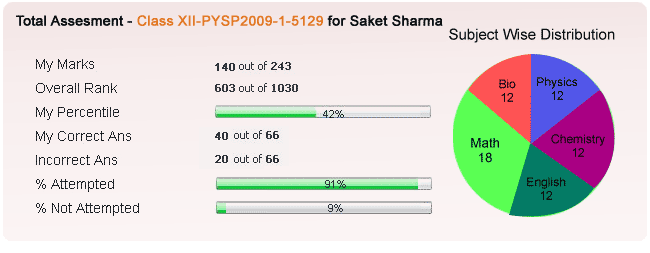




 Chapter-wise presentation of the lessons helped me a lot to stregthen my basics.